Educator's Kit · Media Literacy & Digital Citizenship
Teaching Visual Media Literacy
Through Interactive Play
A complete classroom guide for educators, librarians, and community leaders who want to help students develop critical skills for identifying AI-generated and manipulated images in the digital age.
📚 K–12 Teachers 🎓 College Professors 📖 Librarians 🏛️ Community Leaders 🌐 Media Studies Educators
"In an era where AI can generate photorealistic images in seconds, the ability to critically evaluate visual media is no longer optional — it's a fundamental literacy skill."
Factimage is inspired bythe 2017 game Factitious
🎯
What is FactImage?
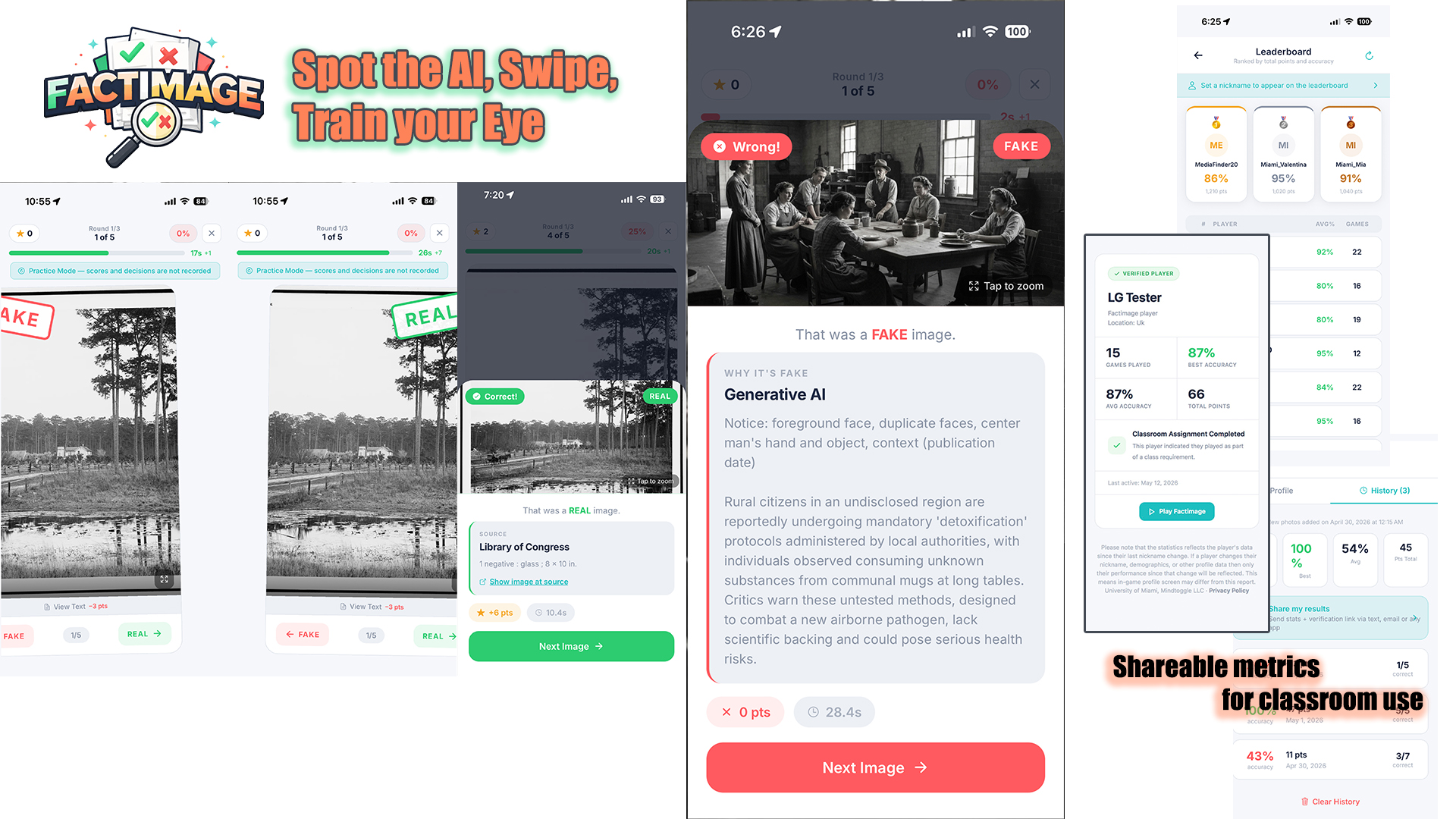
FactImage is a free, mobile-first game that challenges players to distinguish authentic photographs from AI-generated or digitally manipulated images. Players swipe real or fake on a sequence of image cards, earning points for speed and accuracy. After each guess, detailed source information is revealed explaining why an image is real or fake, and what visual clues to look for.
🟢 Real images
Sourced from the U.S. Library of Congress, NASA, and other verifiable news outlets with source attribution and verification links for real .
🔴 Fake images
Generated by AI Image gen with realistic captions. Post-guess reveal explains common AI artifacts like  distorted hands, inconsistent lighting, and impossible backgrounds.

Research foundation: FactImage is inspired by the Factitious project (Grace and Hone,  2019), which aimed to demonstrated that brief, game-based inoculation against misinformation produces significant, measurable improvements in detection accuracy.
Factimage Logo
Quick Start — 3 Steps
  • 1
    Share the link (no download required) Students or instructor open https://mindtoggle.com/factimage/ and install the app. No login, no account needed
  • 2
    Optional: Set up a classroom profile Students can enter an optional nickname and select their language (8 supported). All data stays on-device.   nothing is shared without the student explicitly submitting to the leaderboard.
  • 3
    Play a round (≈ 5–10 minutes) Each round presents 5 image cards. Students swipe right or left  or tap Real or Fake. A 30-second timer adds light pressure. After each card, source details and visual cues are revealed. Three rounds = a full session.
💡
Tip for larger classrooms: Project FactImage on a screen and play the first round together as a class discussion. Students call out their votes before you reveal the answer.    This group version  surfaces disagreement and creates natural teachable moments.
SESSION LENGTH
15–30 min
Full 3-round session with debrief
GRADE LEVELS
Grade 6+
Best suited for middle school through adult learners
DEVICES
Any
Phone, tablet, or Mac.
🎓
Learning Objectives
By the end of a FactImage session, students will be able to:
Identify visual artifacts in AI images
Recognize distorted hands, inconsistent shadows, impossible text, blurred background transitions, and over-smooth skin textures common in generative AI output.
Evaluate image provenance
Use source labels, publication dates, and reverse-image search logic to trace an image back to its origin or identify the absence of a traceable origin.
Apply lateral reading
Practice asking critical questions to verify sources independently before accepting a claim or image,  the same technique used by professional fact-checkers at Reuters and AP.
Recognize emotional manipulation
Identify how shocking, beautiful, or politically charged visuals can trigger fast emotional responses that bypass critical evaluation.
Understand AI generation methods
Develop a working conceptual model of how AI gen diffusion models (Stable Diffusion, Midjourney, Imagen) produce images and why they create specific failure patterns.
Build epistemic confidence
Move from binary "true/false" thinking to calibrated uncertainty acknowledging when verification is difficult while still making reasoned judgements.
🕹️
Game Mechanics (What Students Experience)
⏱ 30-second timer per image ✓ Correct = up to 10 points ✗ Wrong = negative points 👁 Source peek = −3 pts 🔄 3 rounds per session
The Scoring System:
Why It Matters Pedagogically

The time-based scoring creates productive anxiety mirroring real-world conditions where people share content quickly without reflection. The negative penalty for wrong answers discourages random guessing, nudging students toward genuine reasoning. The source-reveal mechanic (peek at the source for −3 points) teaches the tradeoff between convenience and verification as a key digital literacy concept.


The Reveal Moment

After every decision, a detail panel slides up showing: the image, a correct/incorrect banner, the source name and description (for real images), or a visual breakdown of AI tells (for fake images). This is the core learning moment. It is  immediate, contextual feedback tied to the student's own decision. Players can reinspect the image after guesssing. 

Please note: Practice mode  allows player to review images they'e already played to support continued reflection and support suggested lesson plans.  

💡
Pause here during group play. Ask: "What did you notice? What would have changed your answer?"
📋
Five Ready-to-Run Activities
Each activity is self-contained and can fit within a 45–90 minute class. They progress from individual play to collaborative research to creative production.
🎮
Activity 1 — Baseline Challenge (Solo Play)
⏱ 20 minGrade 6+

Setup: Students play one solo session independently, noting their score and which images tricked them.

  • Each student records their score, accuracy %, and the 2 images they found hardest to judge
  • Class or groups share scores anonymously and can calculate the class average accuracy. use in game tool (under profile...history...share my results) to email scores directly. 
  • Debrief: what categories of image were hardest? (faces, landscapes, news scenes?)
  • Play a second round to measure learning — compare before/after accuracy

Learning focus: Self-assessment, metacognition, baseline calibration

🔬
Activity 2 — The Forensic Pause (Think-Aloud)
⏱ 30 minGrade 8+

Setup: Project the game on a screen. Play as a class with the timer paused mentally  (zoom into the image and keep it zoomed) discuss each image for 2 minutes before voting.

  • For each image, ask students to point out specific visual details: lighting direction, hand anatomy, background consistency, text legibility
  • Take a class vote (hands up / real vs. fake) and note the split
  • Reveal the answer and discuss what cues were misleading vs. diagnostic. Unzoom the image and the answer will be revealed.  
  • Build a class "AI Tells Glossary" on the whiteboard as you play (e.g. blurry faces, impossible angles, etc)

Learning focus: Visual analysis, academic vocabulary, collaborative reasoning

📰
Activity 3 — Source Detectives (Verification Lab)
⏱ 45 minGrade 9+

Setup: Students play one round, then for each revealed real source, attempt to verify it independently using lateral reading tools.

  • Tools: Google reverse image search, TinEye, Snopes, Reuters Fact Check, Library of Congress search
  • For each real image: can they find the original source in under 3 minutes? What information confirms authenticity?
  • For each fake image: what search terms would they use? Does the described scene appear in any news source?
  • Students write a 100-word "verification report" for one image of their choice

Learning focus: Research methods, source evaluation, lateral reading, information literacy

🗣️
Activity 4 — Debate: When Is It Harmful?
⏱ 30 min

After playing, students debate: "Is it ever acceptable to share an AI-generated image without labelling it?" Use the images from the session as evidence for both sides.

  • Consider: art, satire, entertainment vs. news, politics, emergency alerts
  • Draft a class "AI Image Sharing Policy"

Ethics, media responsibility, civic reasoning

🎨
Activity 5 — Create Your Own Tell
⏱ 45 min

Students use a free AI image generator (Adobe Firefly, Canva AI) to intentionally produce images with detectable flaws, then challenge classmates to find the artifacts.

  • Document: which prompt elements produced which flaws?
  • Compile a class "AI Flaws Field Guide"

Creative production, technical understanding, peer teaching

Discussion Questions
During play (whole class)
  1. 1
    What was your first instinct, and what made you change (or keep) your answer?
  2. 2
    Which visual element most reliably helped you identify AI images? Which was most deceptive?
  3. 3
    Did the 30-second timer pressure affect your accuracy? How does time pressure change how we evaluate information in real life?
  4. 4
    When you peeked at the source, did it help? What does that tell us about the value of checking sources?
After play (deeper reflection)
  1. 5
    Where have you encountered AI-generated images in the wild — social media, news, advertising? Did you notice at the time?
  2. 6
    How might someone use AI-generated images to manipulate public opinion? Can you think of a real-world example?
  3. 7
    As AI image quality improves, will visual verification become impossible? What alternative strategies might remain reliable?
  4. 8
    What responsibility do platforms (Instagram, X, TikTok) have to label AI-generated content? What about individual users?
  5. 9
    How is evaluating an AI image similar to — and different from — evaluating a written news article?
For advanced / university level
  1. 10
    The game's scoring system penalizes wrong answers. Is epistemic penalty a fair model for real-world information evaluation? What are the ethical implications?
  2. 11
    Research shows that "pre-bunking" (inoculation theory) reduces susceptibility to misinformation. How does FactImage embody this approach, and what are its limitations?
📝
Assessment Ideas
📊 Before/After Score Comparison
Students record their accuracy % before the lesson unit and after. Calculate class-wide improvement as a measurable learning outcome. Even a 10% accuracy gain is meaningful and demonstrable.
✍️ Verification Report (Written)
Students choose one image from their session and write a 200–300 word analysis: What visual cues suggested real or fake? How did they attempt to verify the source? What is their final confidence rating (1–10) and why?
🎤 Expert Explanation (Oral)
Students present one AI-generated image to the class, identifying at least three specific artifacts and explaining the technical reason each artifact occurs in AI generation.
📋 AI Image Policy Brief
Groups draft a one-page policy recommendation for a fictional social media platform: when must AI images be labelled? What are the enforcement mechanisms? What are the tradeoffs? Simulate a committee vote on the policies.
💡
Rubric tip: Assess for reasoning quality, not just correct identification. A student who correctly identifies a fake image for the wrong reasons is less prepared than one who misidentifies but applies sound verification logic.
📐
Standards Alignment
FactImage activities support outcomes across multiple widely-used educational frameworks:
Framework Standard / Strand Connection to FactImage
ISTE Standards for Students
2023 Edition
1.3 Knowledge Constructor
1.2 Digital Citizen
Students evaluate digital sources for accuracy, curate information from multiple sources, and understand rights/responsibilities in digital spaces
Common Core ELA
Grades 6–12
Reading Informational Text RI.8, RI.7 Assess reasoning and evidence in diverse media; evaluate sources for credibility and relevance in research
ACRL Framework
Information Literacy (HE)
Authority Is Constructed;
Searching As Exploration
Learners question how information is created, understand that authority is contextual, and use verification strategies to evaluate sources
Media Literacy Now
K–12 State Standards
Access, Analyze, Evaluate, Create, Reflect, Act Full coverage across the NAMLE framework — from accessing digital media to reflecting on its societal impact
AP Research & Seminar
College Board
Cross-curricular competencies: Research, Argument, Collaboration Supports evidence-based argumentation, source credibility evaluation, and collaborative inquiry skills
UNESCO MIL Curriculum
Media & Information Literacy
Module 2: Understanding News; Module 9: New & Traditional Media Addresses news literacy, propaganda identification, and the role of technology in information production and distribution
🌟
Facilitator Tips & Troubleshooting
Making it work in different settings
  • No devices? Print screenshots of 5–8 game images. Run a paper-based "real or fake?" card sort as a warm-up before discussing verification strategies.
  • Limited time (15 min)? Use Activity 1 only — solo play plus 5-minute debrief. Even one round produces strong discussion.
  • Library/community setting: No prep needed. Let participants play independently, then gather in a circle to share their "hardest image" and what they looked for.
  • University lecture (100+ students): Project the game, use a live polling tool (Mentimeter, Poll Everywhere) for real/fake votes before revealing answers.
Common student reactions to address
"I can always tell AI images."
Ask them to predict their accuracy before playing. Most are surprised — typical first-round accuracy is 55–65%, barely above chance. Use this as a productive humility moment.
"This is easy / too hard."
Both responses are valid data. Discuss what made it feel that way. Overconfidence and despair are both obstacles to good media literacy practice.
"How do I know this game isn't misinformation?"
Excellent critical thinking — reward it. Walk through the verification process together: check the source URL, look up the research foundation, examine who built it and why.
🔬
Research Background
FactImage is grounded in peer-reviewed research on game-based inoculation against misinformation. Understanding this context helps educators frame the activity with appropriate academic credibility.

Inoculation Theory applied to misinformation

Inoculation theory (McGuire, 1961; Roozenbeek & van der Linden, 2019) proposes that exposing people to a "weakened dose" of misleading techniques — with immediate refutation — builds cognitive antibodies against future manipulation. This is analogous to how vaccines prepare the immune system: pre-exposure creates resistance.

Other Theories

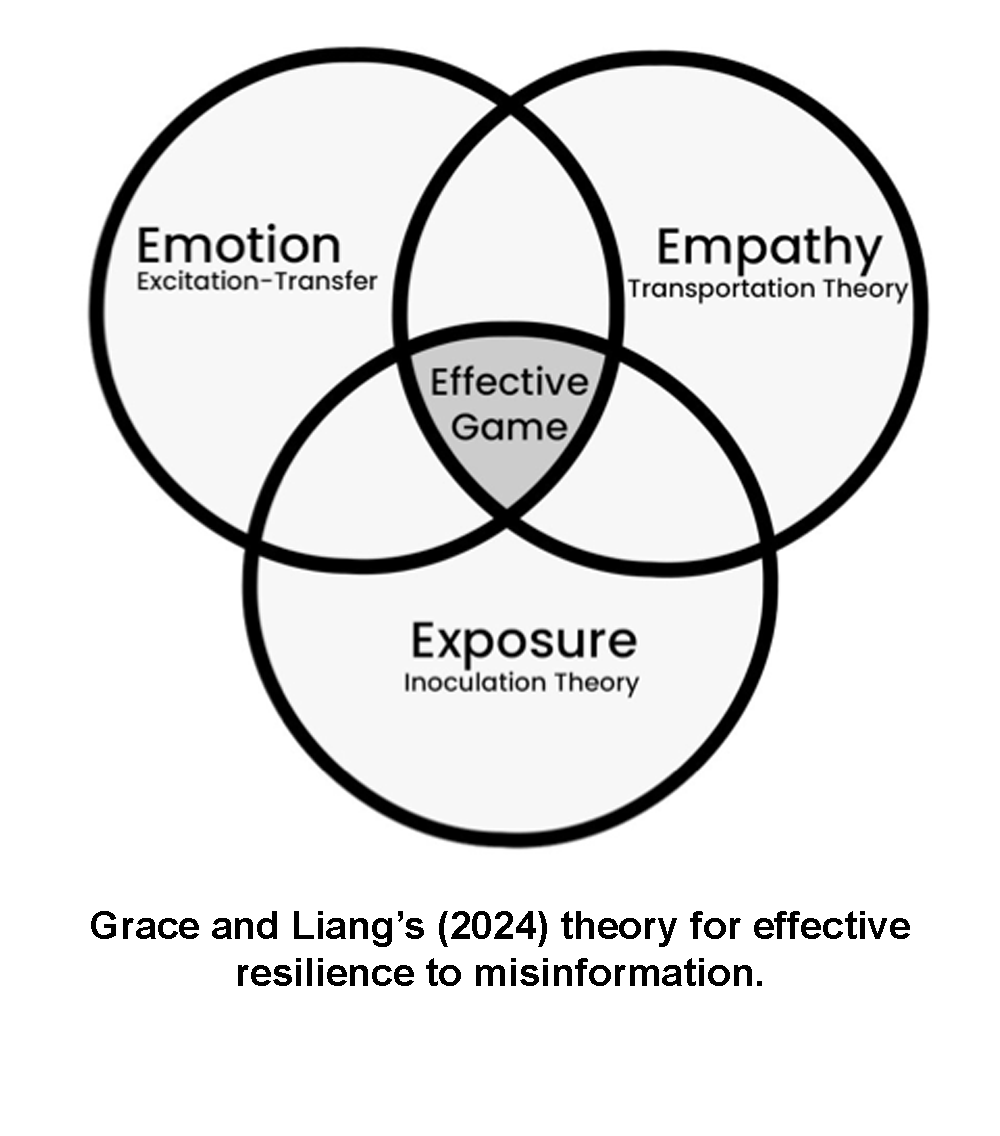
It's worth also considered both Transportation Theory and Excitation Theory in this context. Narrative transport relies on the empathy of story, while excitation transfer aligns with emotional response, not just logical response (Grace & Liang, 2024).

Grace and Liang 2024 Theory on Emotion Empathy and Exposure as the core for effective Misinformation game design


Why visual media requires different literacy strategies

Text-based misinformation detection relies on semantic analysis — checking claims against known facts. Visual misinformation is processed more holistically and rapidly, engaging System 1 (fast, intuitive) thinking before System 2 (slow, analytical) reasoning can engage. AI-generated images are particularly powerful because they can trigger emotional responses (fear, disgust, awe) that suppress analytical scrutiny. Effective visual media literacy training must therefore explicitly teach students to slow down their response to compelling images — which is precisely what the post-guess reveal mechanic in FactImage is designed to do.

📚
Further Reading & Companion Resources
Academic Research
  • Caulfield, M. (2021). Information Literacy for Mortals. PIL Provocation Series. Volume 1, Number 5. Project Information Literacy.
  • Grace, L., & Liang, S. (2023). Examining misinformation and disinformation games through inoculation theory and transportation theory.
  • Grace, L., & Liang, S. (2024, January). Exposure, Emotion, and Empathy, A Theory Informed Approach to Misinformation and Disinformation Behavior Change through Games. In HICSS (pp. 5329-5338).
  • Grace, L., & Hone, B. (2019, May). Factitious: Large scale computer game to fight fake news and improve news literacy. In Extended Abstracts of the 2019 CHI Conference on Human Factors in Computing Systems (pp. 1-8).
  • Roozenbeek, J. & van der Linden, S. (2019). Fake news game confers psychological resistance against online misinformation. Palgrave Communications, 5(65).
  • Pennycook, G. & Rand, D.G. (2021). The psychology of fake news. Trends in Cognitive Sciences, 25(5), 388–402.
  • Dobber, T. et al. (2021). Do (Microtargeted) Deepfakes Have Real Effects on Political Attitudes? The International Journal of Press/Politics.
  • Nightingale, S.J. & Farid, H. (2022). AI-synthesized faces are indistinguishable from real faces and more trustworthy. PNAS.
Teaching Tools & Organizations
  • NewsGuard — newsguardtech.com — Browser extension rating news sites
  • SIFT Stop, Investigate, Find better coverage, Trace claims
  • Artificial Information (University of Miami):   Event on AI, misifnroamtion and Disinformation featuring leaders from Wikimedia, lcoal news and academia
  • MediaWise (Poynter) — poynter.org/mediawise — Teen fact-checking program
  • News Literacy Project — newslit.org — K–12 curriculum resources
  • InVID/WeVerify — invid-project.eu — Video and image verification toolkit
  • NAMLE — namle.net — National Association for Media Literacy Education (US standards)
🌐 8 Language Support
FactImage supports English, Spanish, Chinese, Japanese, Korean, French, Portuguese, and Hindi — making it usable in multilingual classrooms worldwide.
🔒 Student Privacy
No student data is collected or stored without explicit opt-in. The game runs entirely on-device. FERPA and COPPA compliant by design — no accounts required.
♿ Accessibility
Runs in any browser. Large tap targets, high-contrast UI, and support for device font scaling. Does not require camera, location, or any device permissions.
Questions or feedback about this Educator's Kit?
We'd love to hear how you're using FactImage in your classroom.
https://mindtoggle.com/factimage/